UK Plug-in Solar 2026: What Changed on 27 August?
Two instruments commenced on 27 August 2026: SI 2026/848 made plug-in solar legal, SI 2026/896 brought it inside planning permitted development.
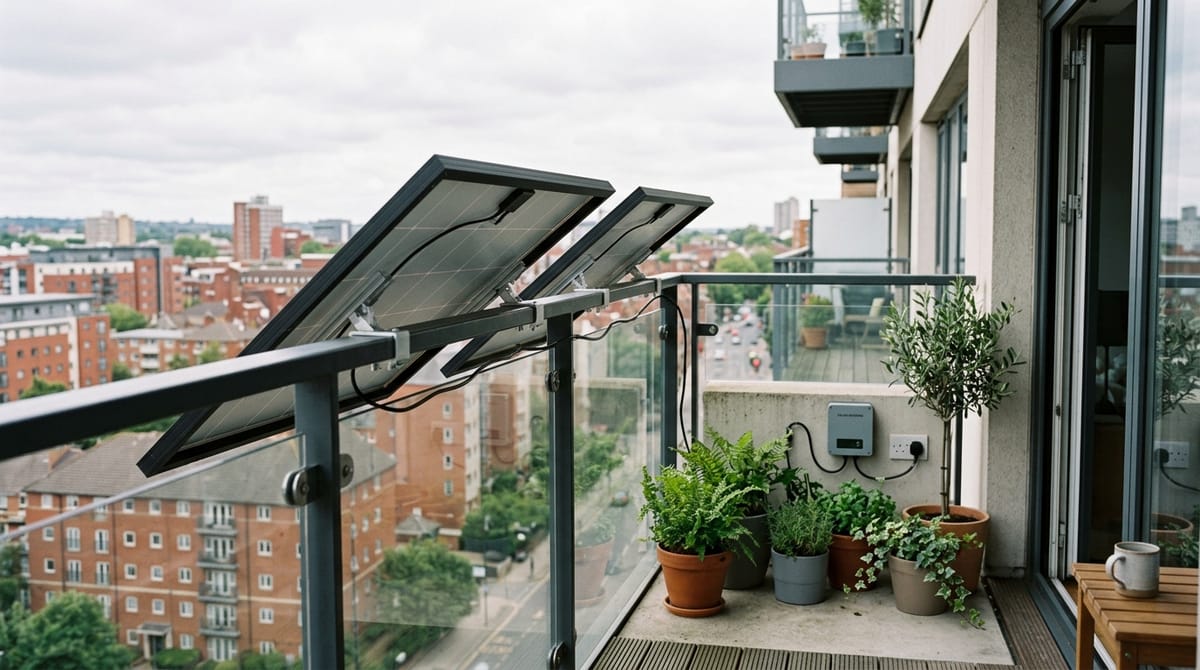
UK plug-in solar in 2026 has moved from a legal grey area to a defined, regulated product. On 27 August 2026 a new law gave households a legal way to plug a small solar system straight into a socket, the same idea that put solar panels on millions of German balconies. This is the tracker for that change: what actually changed on the day, what the rules let you do, and how to make sure the kit you buy is one of the certified ones. Dates and details here are current as of September 2026.
What exactly changed on 27 August 2026?
On that date, SI 2026/848 (the statutory instrument amending the Plugs and Sockets etc. (Safety) Regulations 1994) came into force. It created a legal category called a plug-in microgenerator: a battery-less solar system, up to 800W, designed to connect to a standard UK three-pin socket using an approved plug. In plain terms, it is now legal to generate your own solar electricity from a panel that plugs in, with no rooftop installation and no rewiring.
The reform is the output of a government process, not a retailer promise. The Department for Energy Security and Net Zero (DESNZ) consulted on the change and published the technical requirements in its plug-in solar consultation document. For the full legal background, see our explainer on whether plug-in solar is legal in the UK.
How is this different from the old rules?
Before 27 August 2026, there was no approved way to plug a solar generator into a UK socket. The old Plugs and Sockets regulations were written long before balcony solar existed, so a plug-in system sat outside them. That is the gap the new law closed.
Since the change, the position has flipped: a plug-in microgenerator that meets the official specification and connects through an approved plug is expressly permitted, up to the 800W ceiling. The distinction that matters is that the law legalises a type of product used correctly, not any panel you happen to plug in. Buying random panels and wiring your own plug is still non-compliant.
Why are there two instruments, not one?
Almost everything written about 27 August 2026 covers SI 2026/848, the product-safety instrument above. A second one commenced the same day and gets far less attention: SI 2026/896, which amends the permitted-development rules. The first makes the connection lawful; the second decides where you are allowed to put the thing.
Its key move is a definition. Article 5 inserts "plug-in solar" into the planning rules and adds it to the existing definition of solar PV, so from that date a plug-in kit sits inside the same permitted-development regime as any other domestic panel. Until this change the common answer, that a plug-in system is too temporary and reversible for planning to bite, was reasoning rather than law. That gap has closed.
For most balcony and wall installations this changes little in practice, because they were unlikely to need an application either way. Two groups should read the detail:
- Anyone putting panels in the garden. The rules for free-standing installations are now more generous for houses. The flat ban on siting within five metres of your boundary has been replaced by a sliding height limit, and the three-metre array-dimension cap and the one-installation-only rule have fallen away. A corner of the garden that was off limits before is now usable. See garden solar for the before and after.
- Anyone mounting on wood. The order specifically excludes plug-in solar fixed to a wooden wall, balcony or enclosure, to a timber-clad exterior, or to a wooden fence or gate. That converges with the product specification's fire-safety ban on timber balconies and cladding, but it reaches further: a garden fence is not on the fire-safety list at all.
One transitional point. If an installation was permitted development immediately before 27 August 2026 and the new limits take it outside, you may still carry it out until the end of 26 August 2027. We set out the full Class A and Class B limits on the legality page, and the planning permission guide covers the exclusions in full. These are England; Scotland, Wales and Northern Ireland run separate planning regimes.
What does the 800W limit actually mean?
The 800W figure is an AC output limit measured at the microinverter (the small box that converts the panels' DC electricity into AC mains electricity), not a limit on panel size. You can sit a larger panel array behind the inverter, because the inverter caps what actually reaches your sockets at 800W. The instrument itself sets no panel limit at all - it specifies only "a maximum rated alternating current output not exceeding 800 watts". The array ceiling comes from the other document: DESNZ's Plug-in Solar Device Interim Product Specification, which brings arrays of up to 2,000W within its scope. So a compliant kit can pair roughly 2,000W of panels with an 800W inverter. In practice that headroom helps the system hit its 800W ceiling more often on dull British days.
800W is also the household cap under the grid-connection rules described below, so it is the number that defines a compliant single plug-in system.
Can you buy a certified kit now?
Legalisation and availability are two different things. To be legal, a kit must meet DESNZ's Interim Product Specification (the minimum technical standard covering electrical design, the BS 1363 plug, mounting and fire protection) and be sold as a single certified whole product: panel, inverter, factory-fitted cable and plug, and mounting system together. Separately-sourced parts, imported kits or modified cables do not qualify.
Crucially, no product can be sold until it appears on the ENA Type Test Register (the industry register a plug-in solar product must be listed on before sale). Certification has now caught up with the law: the first plug-in solar kit was certified on 18 August 2026, and by early September 2026 trackers following the register were reporting roughly 40 compliant kits from about a dozen manufacturers. The register is browser-only with no public data feed, so any count - including this one - is a dated snapshot. Check the entry for the exact model you plan to buy, because uncertified kits are still on sale and are still illegal to plug in.
Do you still have to notify anyone?
Yes. Even now the law is in force, connecting a plug-in microgenerator to the grid falls under G98, the engineering recommendation for small generators, on a "Connect and Notify" basis. That means you tell your Distribution Network Operator (DNO, the company that runs the local electricity network in your area) that the system is connected. Until G98 is formally amended to accommodate these devices, the effective ceiling stays at 800W per household.
This is a notification, not a permission slip you wait months for, but skipping it is not optional for a grid-connected system.
What still isn't allowed?
No batteries
SI 2026/848 covers battery-less systems only. A plug-in system that stores electricity for later is a separate regulatory question and is excluded from this reform.
No mounting on high-risk cladding or timber balconies
Installation is not permitted on ACM or MCM cladding, high-pressure laminate cladding, timber cladding, or timber balconies, for fire-safety reasons.
No extension leads or adaptors
The factory-fitted AC cable must not be extended with an extension lead, multi-way adaptor or RCD adaptor. It plugs straight into the socket.
No self-built or imported kits
Only a certified whole product on the ENA register is compliant. Mixing your own components keeps you outside the rules.
Renters still need landlord sign-off
Plug-in solar is reversible and leaves nothing behind, but leaseholders and tenants should still get freeholder or landlord consent before mounting anything.